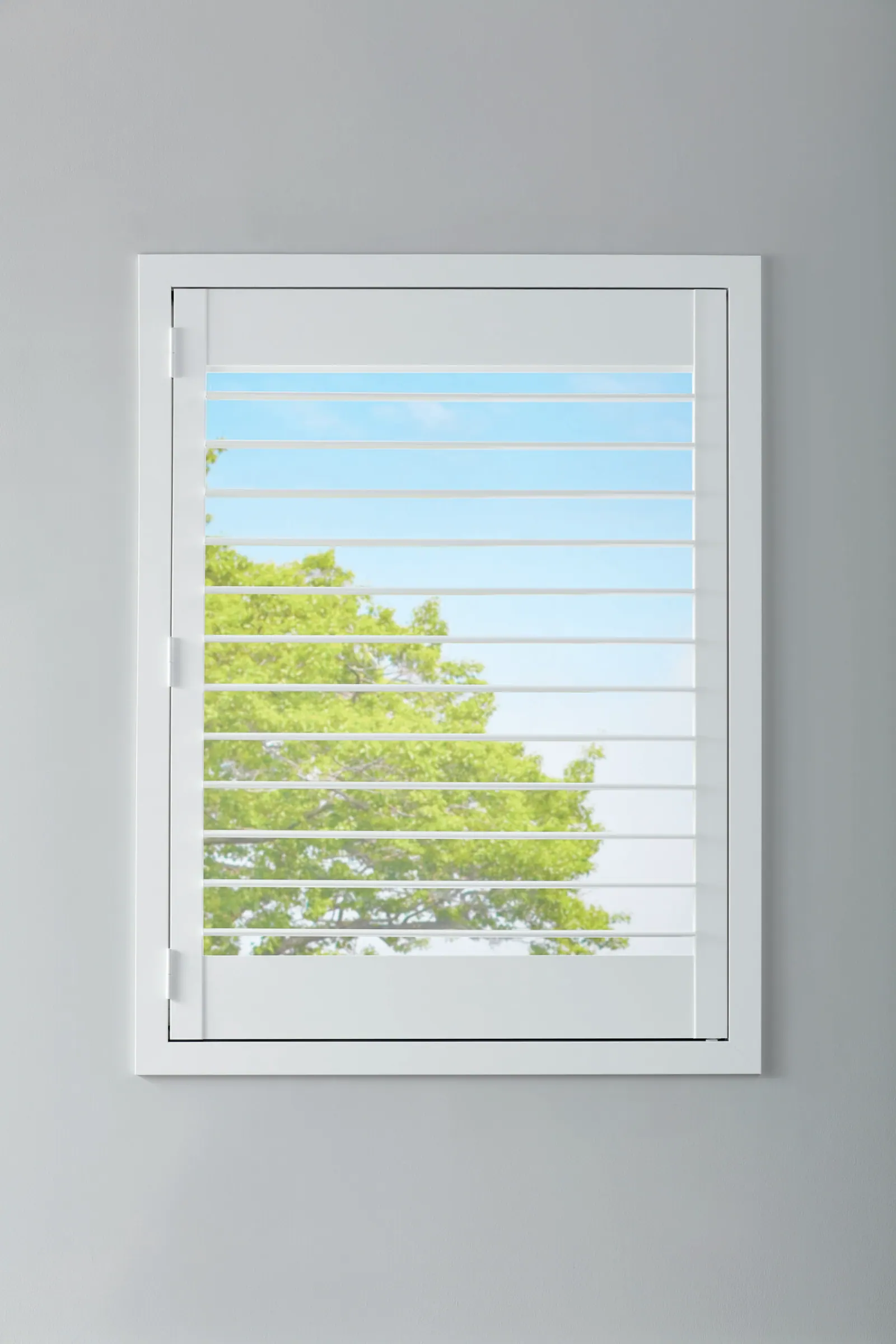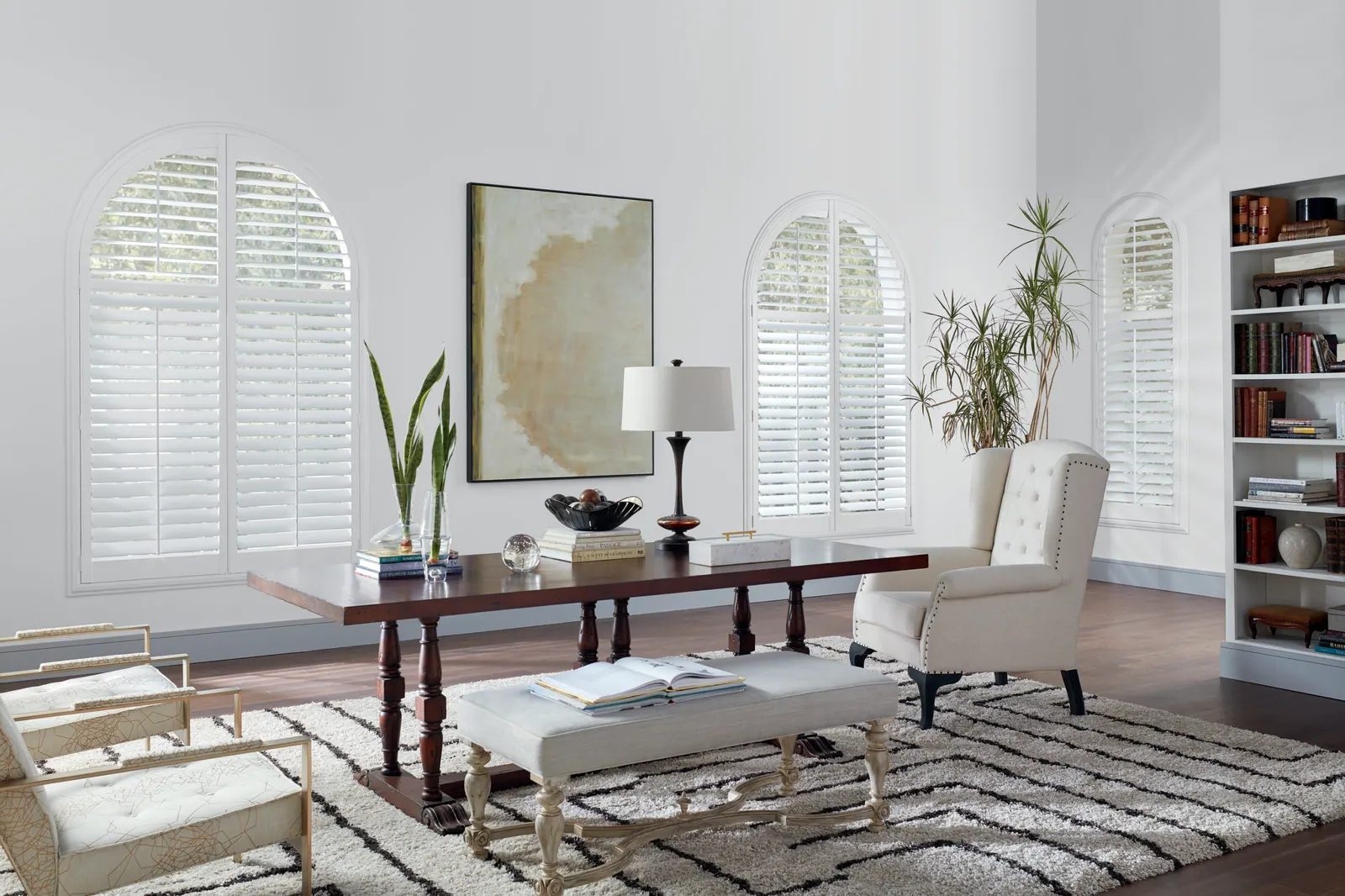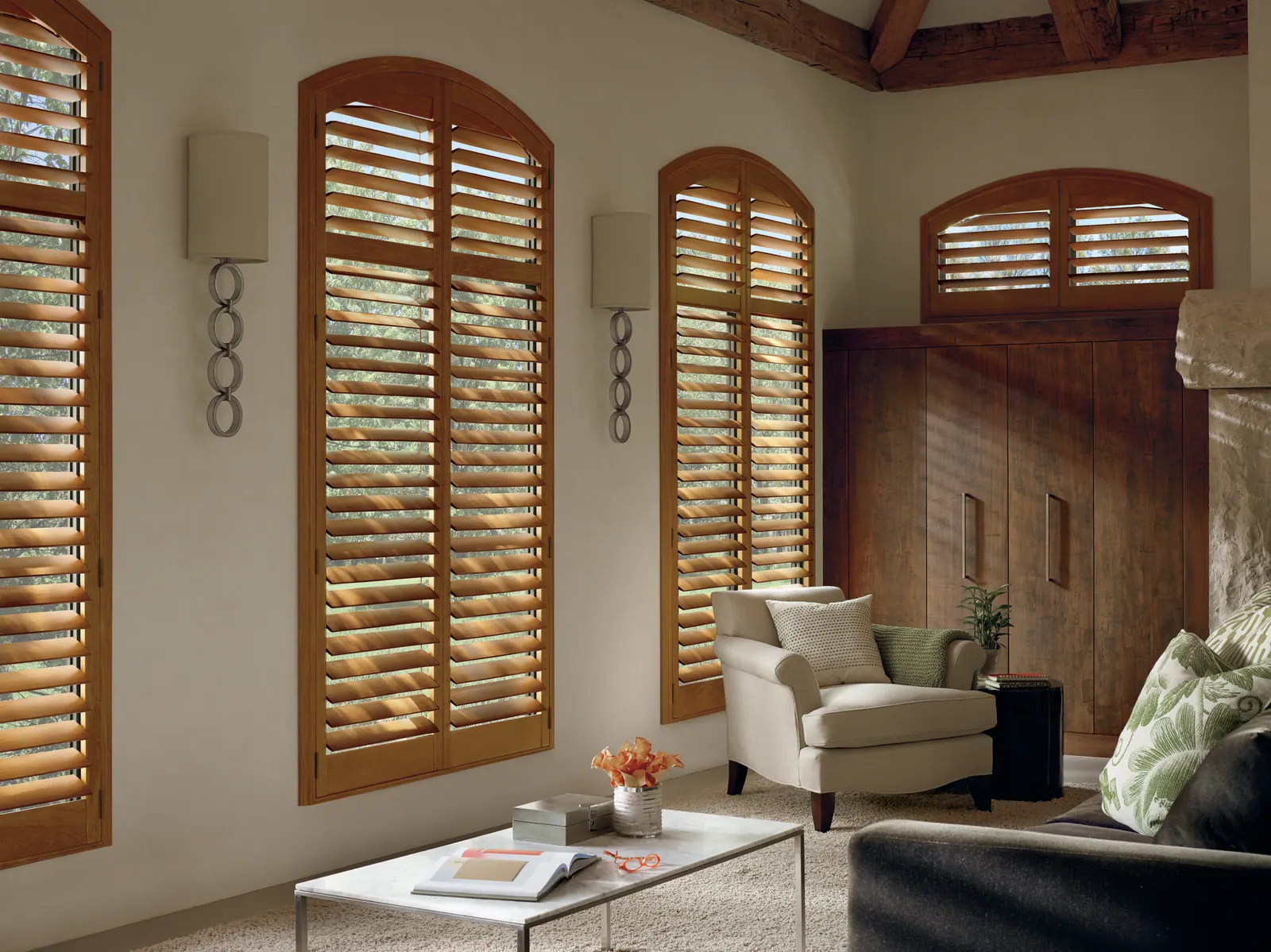
A plantation shutter is an interior shutter with wide, adjustable louvers, fitted directly into the window opening rather than hung in front of it. That last part is the important bit. It is why a shutter reads as architecture and a blind reads as a covering.
What makes it a plantation shutter
The defining feature is louver width. A traditional shutter uses narrow slats, an inch or two across, closely spaced. A plantation shutter uses louvers of 2½ inches at the narrowest and more commonly 3½ or 4½ inches, with correspondingly fewer of them per panel.
That single change does a lot of work. Fewer louvers means fewer horizontal lines across the glass, so you see more when they are open. Wider louvers also close more tightly against each other, so they block more light when shut. And the proportions read as deliberate, closer to cabinetry than to hardware.
The name is American, from the antebellum South, where wide louvers were used to move air through a room while cutting direct sun. The physics have not changed: louvers angled upward bounce daylight onto the ceiling and light a room evenly without putting sun on your floors.
How a shutter is actually built
A shutter panel has four parts, and knowing them makes quotes much easier to read.
- Stiles are the vertical members at each side of the panel.
- Rails are the horizontal members at top and bottom, plus any divider rail across the middle.
- Louvers are the moving slats.
- The frame is what fixes the whole assembly into the window opening.
The frame is what most distinguishes a good installation from a mediocre one. An L-frame suits windows with existing casing. A Z-frame suits drywall-wrapped openings with no trim. A build-out frame adds depth where the window is too shallow to take a panel. Choosing the wrong one is the most common flaw we see in shutters someone else installed.
Materials: hardwood or composite
Hardwood, usually kiln-dried basswood, is lighter, can be stained to show grain, and handles specialty shapes like arches and angles. It is the right choice when the finish is stained, when panels are very wide, or when the window is not a rectangle.
Composite is engineered wood wrapped in a polymer skin. It cannot be stained, but it is impervious to moisture, will not warp in hard sun, costs 15–25% less, and holds white finishes without yellowing. For bathrooms, kitchens and west-facing windows it is simply the better material.
In Colorado Springs, where winter humidity often sits below 20% and the sun at 6,035 feet is unusually intense, that durability difference matters more than it would at sea level. Roughly half the shutters we install are composite for exactly this reason. There is a fuller comparison in Plantation Shutters: Wood vs Composite.
Choosing a louver size
- 2½ inch: traditional and fine-scaled. Best on smaller windows and in older homes where the architecture is modest.
- 3½ inch, the most common size and a sensible default. Enough view when open, still finely detailed.
- 4½ inch: contemporary, with the fewest lines across the glass and the most unobstructed view. This is what we specify when a window frames Pikes Peak and the view is the point.
Hold samples against the actual window before deciding. The difference between 3½ and 4½ looks small in a brochure and substantial on your wall.
Are they worth it?
Shutters are the most expensive window treatment in most quotes, and worth being straightforward about. What you get for that is permanence: a well-built shutter outlasts three or four sets of blinds, does not need replacing when you repaint, and is treated by buyers and appraisers as a fixture that conveys with the house rather than a furnishing you take with you.
The case is weakest on windows where you want the treatment to disappear, or where the whole point is an uninterrupted view, a solar screen or roller shade may serve better there. It is strongest on street-facing rooms, specialty-shaped windows, and any elevation taking hard afternoon sun.
Common questions
- What is the difference between plantation shutters and regular shutters?
- Louver width. Plantation shutters use wide louvers, 2½ inches and up, while traditional shutters use narrow slats. Wide louvers give more view when open and a cleaner, more architectural appearance.
- Do plantation shutters go inside or outside the window?
- Interior plantation shutters fit inside the opening, mounted to a frame fixed into the window jamb. Exterior shutters are a separate product entirely, decorative or storm shutters on the outside of the house.
- How much do plantation shutters cost?
- Pricing is per opening and depends on size, material, louver width and any specialty shape. A painted composite shutter on a standard bedroom window typically lands in the mid hundreds installed; hardwood on a large or shaped opening runs meaningfully more.