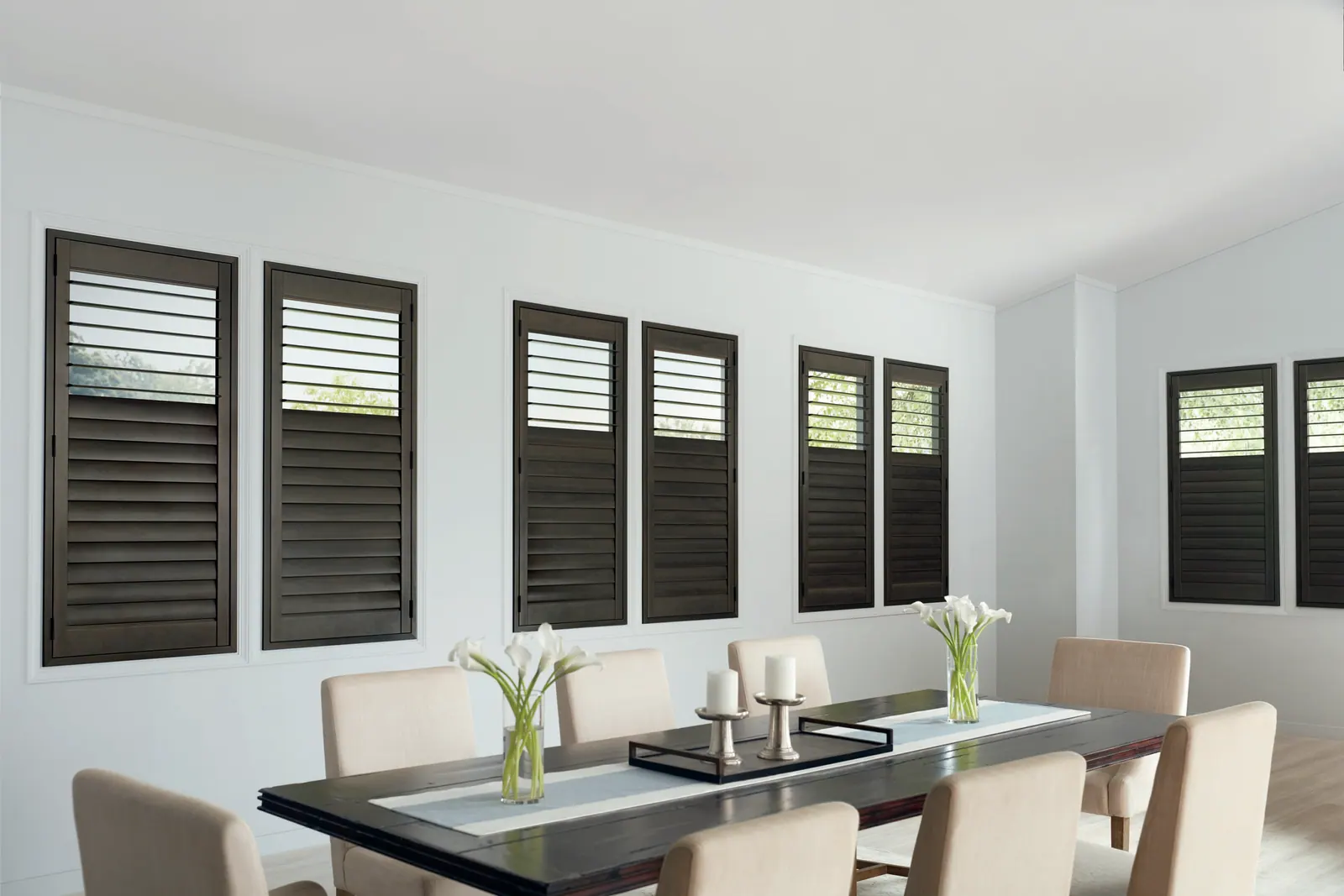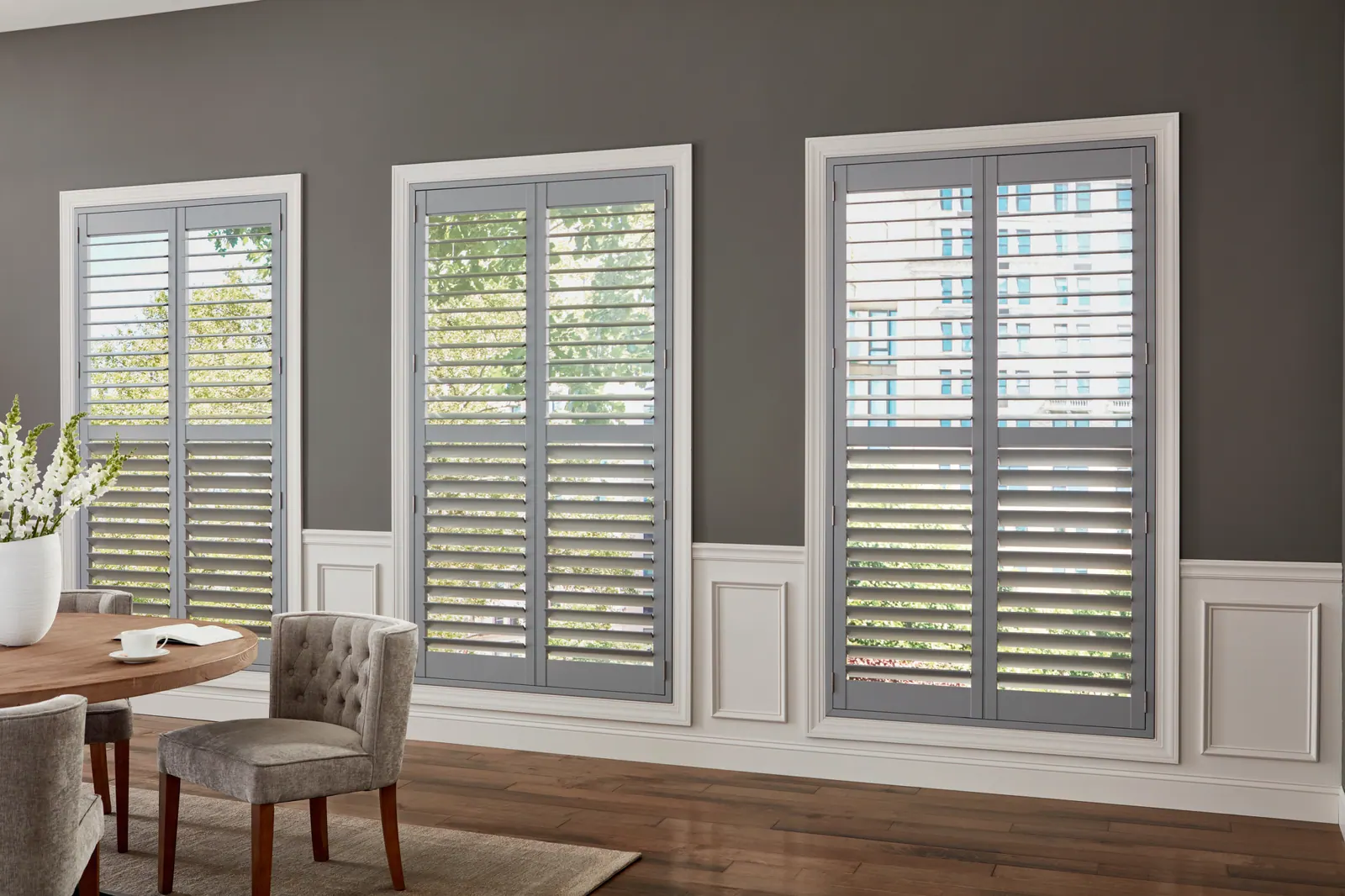
What makes a plantation shutter different
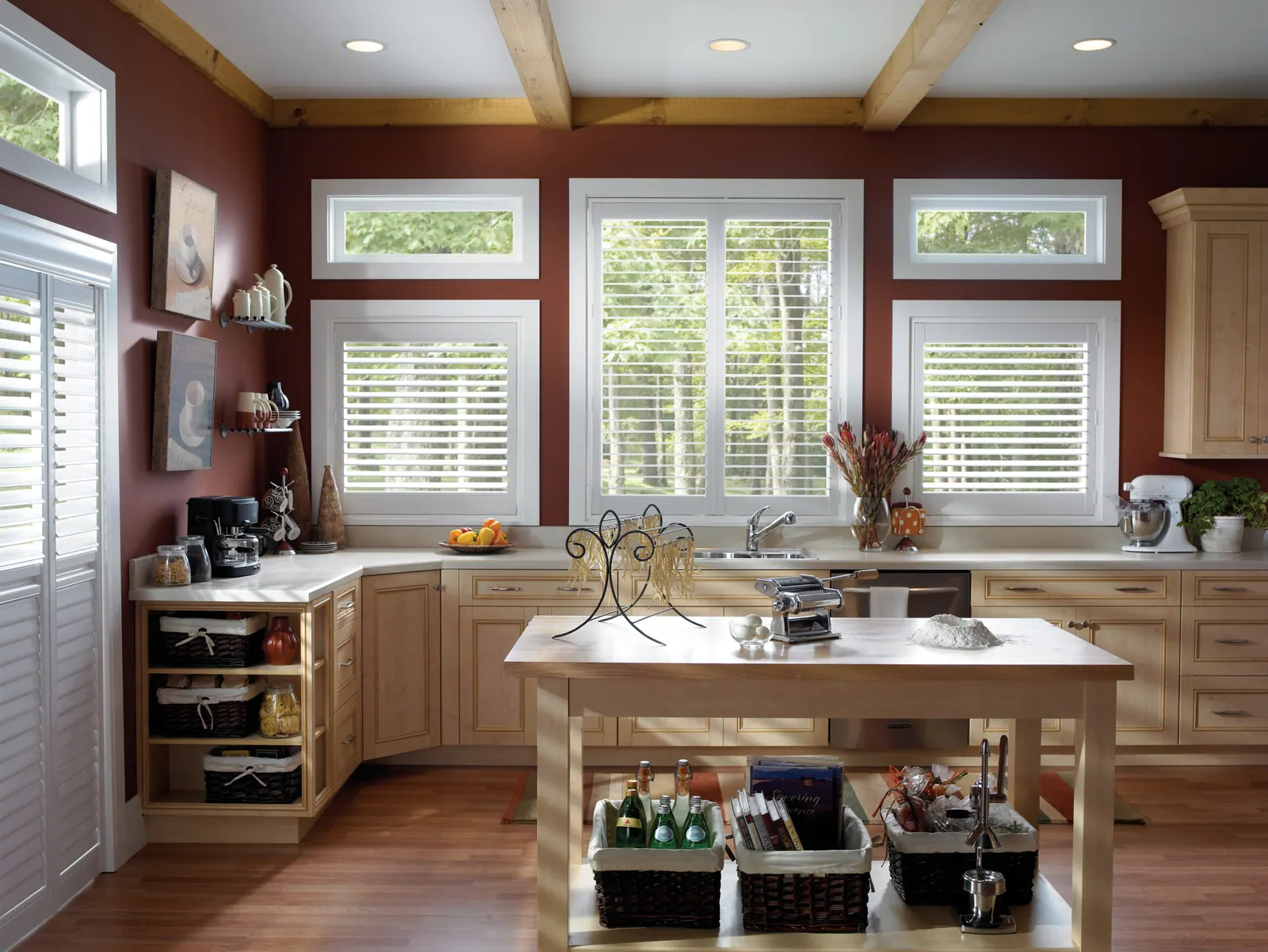
The distinction is the louver. A traditional shutter uses narrow slats, an inch or two wide, closely spaced. A plantation shutter uses wide louvers (2½ inches at the narrowest, more commonly 3½ or 4½) with fewer of them per panel. The result is more view when open, a cleaner face, and a look that reads as deliberate architecture rather than a covering hung over a hole.
The name comes from the antebellum American South, where wide louvers were used to move air through a room while cutting the sun. The physics still apply in Colorado: louvers angled upward bounce daylight onto the ceiling and light a room evenly without letting direct sun onto your floors and furniture.
Why we build ours from basswood
We use kiln-dried North American basswood for hardwood plantation shutters, and the reason is specific to this climate. Basswood has a tight, even grain and a low density, which gives you two things that matter here: it is dimensionally stable as humidity swings, and it is light enough that a wide panel does not sag on its hinges over time.
Colorado Springs runs extremely dry, often under 20% relative humidity through winter, then gets monsoon moisture in July and August. Woods with open grain and higher moisture content move noticeably through that cycle. Basswood moves less, and our stiles and rails are finger-jointed and laminated rather than cut from single pieces, which further resists the twist and check that dry air causes in solid stock.
It also takes paint exceptionally well. A painted basswood shutter has a smooth, furniture-grade finish with no grain telegraphing through, which is what most Colorado Springs homeowners are after.
Painted or stained
Roughly four out of five plantation shutters we install are painted white or off-white. There are good reasons for that beyond fashion: white reflects rather than absorbs the intense high-altitude light, it reads consistently from the street, and most HOAs in the newer Colorado Springs developments (Flying Horse, Cordera, Banning Lewis Ranch, Wolf Ranch) have covenants requiring white or neutral window coverings as viewed from outside.
Stain is the reason to choose hardwood over composite. If you have alder or knotty pine trim, a stained shutter can be matched to it in a way that no composite product will convincingly imitate. We carry 22 stains and can custom-match to a trim sample you provide. Bring us a spare piece of casing or a cabinet door and we will match to the real thing rather than to a photograph.
One practical note on stain: it shows dust less than white but shows scratches more. In a house with dogs and a low window, that trade sometimes matters.
Fitting specialty windows
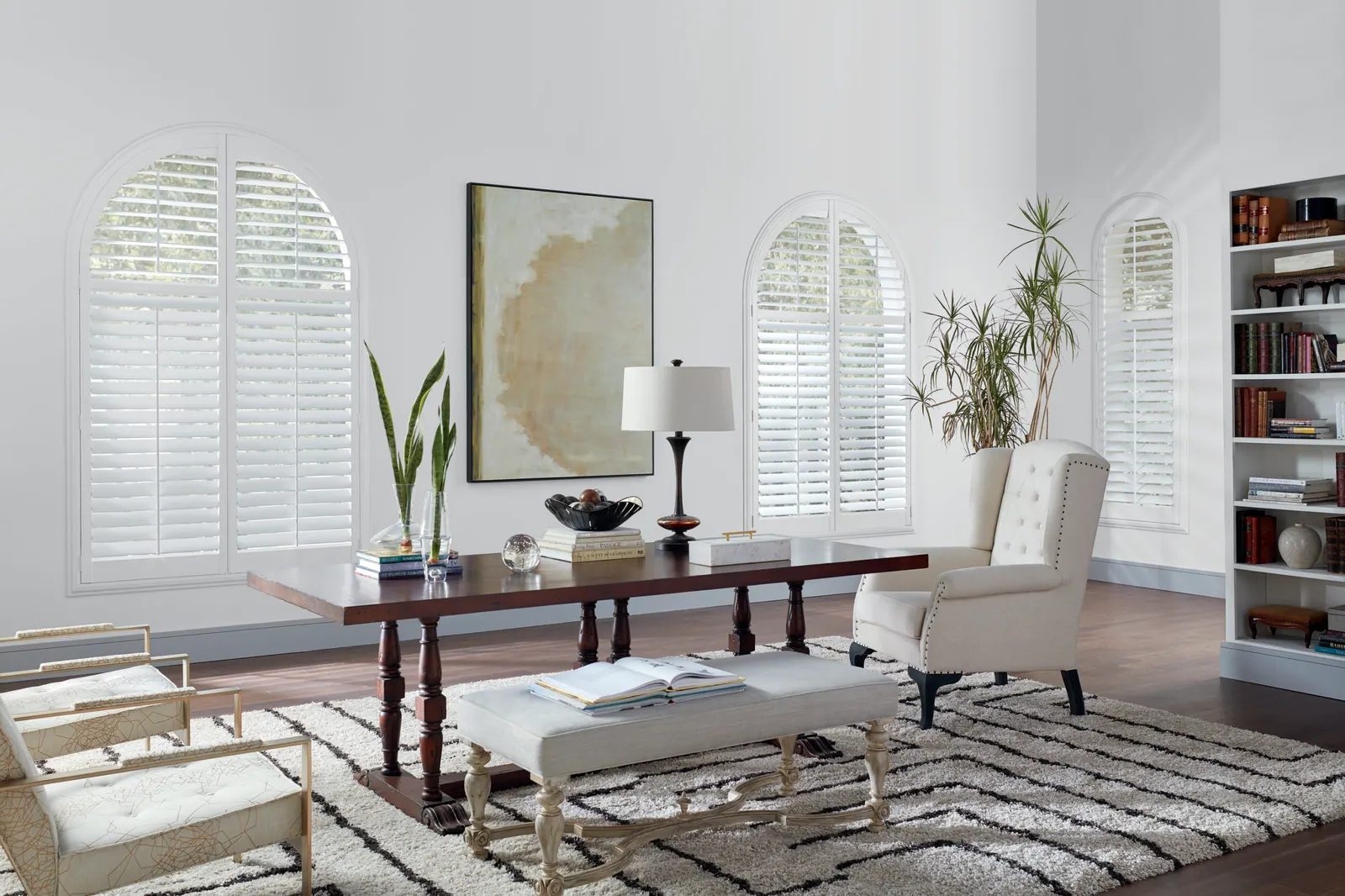
Colorado Springs has a lot of non-rectangular glass. Arch tops over entry doors, eyebrow windows, angled rakes following a vaulted ceiling, octagons in stairwells. These are exactly the openings that look wrong with a blind and right with a shutter.
- Arches and eyebrows can be built as a fixed sunburst, louvers radiating from a centre hub, or with operable louvers on a curved rail. Fixed is more common and considerably less expensive.
- Angled and rake tops follow the ceiling line. These are templated on site; a stated angle is almost never accurate enough.
- Circles and octagons are built as fixed frames with operable louvers where the geometry allows.
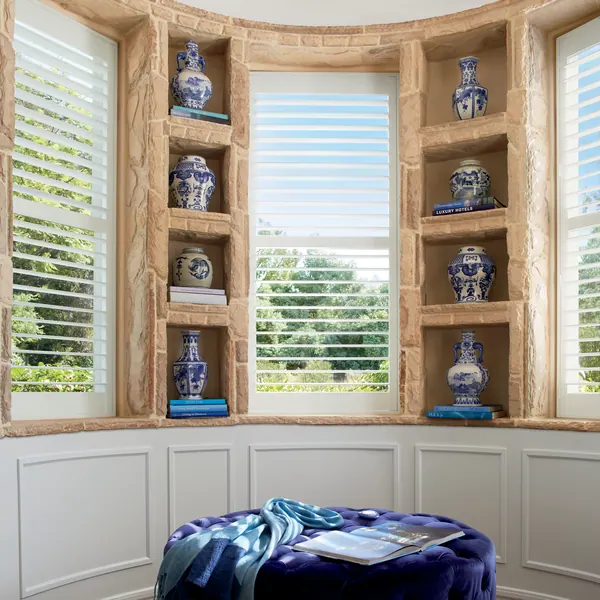
- Bay and bow windows need mullion posts where the panels meet. We work out the post placement so it lands on the window frame junction rather than in the middle of a pane.
Every specialty shape is templated in person. We make a physical pattern of the opening rather than trusting a measurement, because a half-degree of error on an arch is visible from across the room.
Hinges, frames and the details that show
The frame is what makes a shutter look built-in rather than added. We specify the frame style to the opening: an L-frame for windows with existing casing, a Z-frame for drywall-wrapped openings without trim, and a build-out frame where the window is too shallow to take a panel without one. Getting this wrong is the most common flaw we see in shutters installed by someone else.
Hinges should match the finish, not merely coordinate with it, and on a painted shutter they should be painted to match rather than left as bare metal. Soft-close hinges are available and are genuinely worth it on shutters that get operated daily, they stop the panel banging against the frame.
We also recommend a hidden tilt on any shutter where the view matters. Removing the centre tilt rod takes a visual line off the face of the panel, and once you have seen the two side by side it is difficult to unsee.
Common questions
- How much do plantation shutters cost in Colorado Springs?
- Pricing is per opening and depends on size, material, louver width, finish and any specialty shape. As a rough guide, a painted composite shutter on a standard bedroom window typically lands in the mid hundreds of dollars installed, and hardwood on a large or shaped opening runs meaningfully higher. We quote after measuring, because shutters are priced on real dimensions rather than size brackets, and we give you a per-window breakdown rather than a single lump figure.
- What louver size should I choose?
- 3½ inch suits most windows and is what we install most often. Go to 4½ inch when the window frames a view you want to preserve, or when the room is contemporary and you want the fewest horizontal lines. Drop to 2½ inch on small windows and in older homes where a finer scale suits the architecture.
- How long do plantation shutters last?
- A well-built hardwood shutter is a 20-plus year product, and many of the shutters we installed in the mid-2000s are still in daily service. The failure points are hinges and tilt mechanisms rather than the panels themselves, and both are serviceable. This is the main argument for shutters over blinds: you buy once.
- Can plantation shutters be installed on sliding doors?
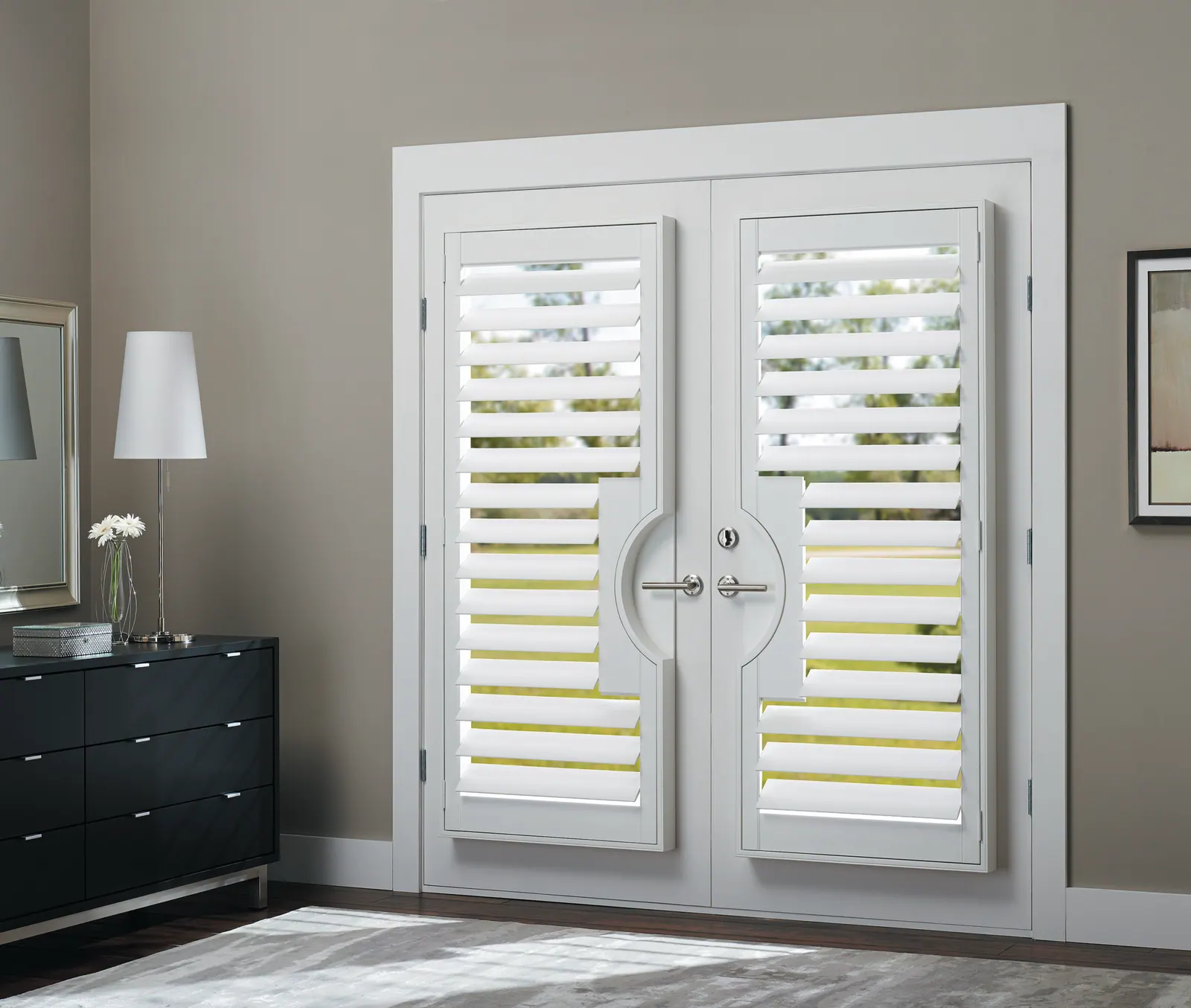
- Yes, on a bypass or bi-fold track. Bypass panels slide past each other like the door itself; bi-fold panels fold back against the jamb. Both need adequate stacking room to one side, which we check at measurement. For very wide openings a vertical treatment is sometimes the better answer, and we will say so if it is.
- Do plantation shutters help with heating and cooling?
- They help meaningfully with solar heat gain, which is the bigger issue in Colorado Springs, closing louvers on a west-facing window on an August afternoon makes a noticeable difference to how hard the air conditioning works. For winter heat retention, a cellular honeycomb shade insulates better because it traps air; a shutter's benefit is the sealed frame and the solid louver, not trapped air.