Why shutters make sense at 6,000 feet
Colorado Springs sits at just over 6,000 feet with more than 300 days of sun a year. Ultraviolet intensity climbs roughly 4% for every 1,000 feet of elevation, which means the light coming through your south and west windows is meaningfully harsher than the same light at sea level. Fabric shades fade. Vinyl blinds go brittle and yellow. Cheap cellular material loses its crispness in a handful of summers.
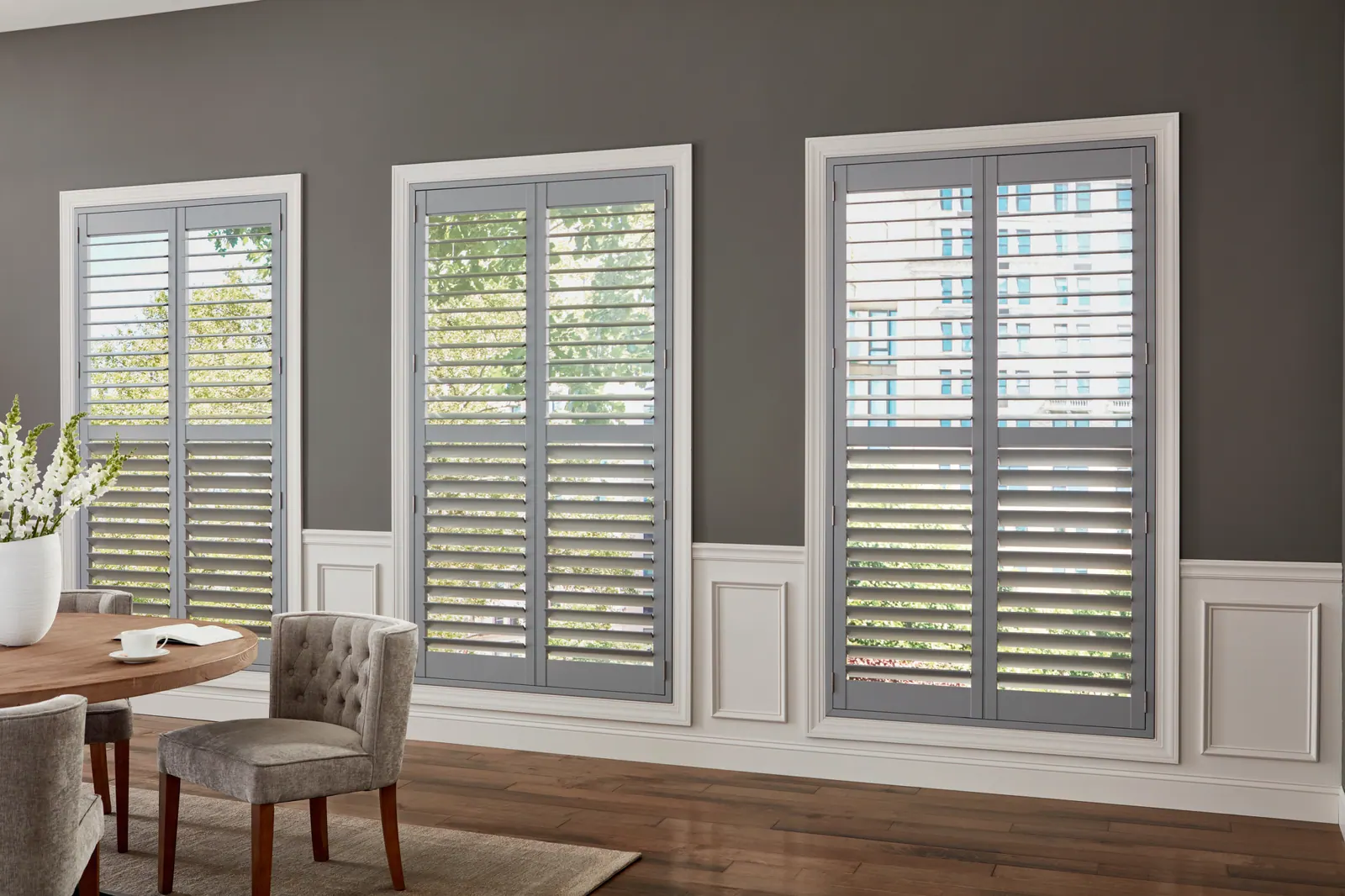
A shutter has no fabric to fade and no cords to fray. The louvers are solid, and when they are closed they form a physical barrier that blocks light rather than filtering it. That is why shutters are the treatment we most often recommend for west-facing great rooms in Flying Horse, Cordera and Wolf Ranch, where the afternoon sun comes in low and hot from spring through October.
The second local factor is humidity, or the lack of it. Colorado Springs averages well under 20% relative humidity in winter. Real hardwood moves in that environment, which is why our hardwood shutters are built from kiln-dried basswood with finger-jointed stiles rather than solid one-piece rails. It is also why, for bathrooms, laundry rooms and homes with big seasonal swings, we often steer people toward composite instead.
Hardwood or composite: how to choose
There is no universally better material. There is a better material for a given window. Here is how we actually make the call during a consultation.
Choose hardwood when
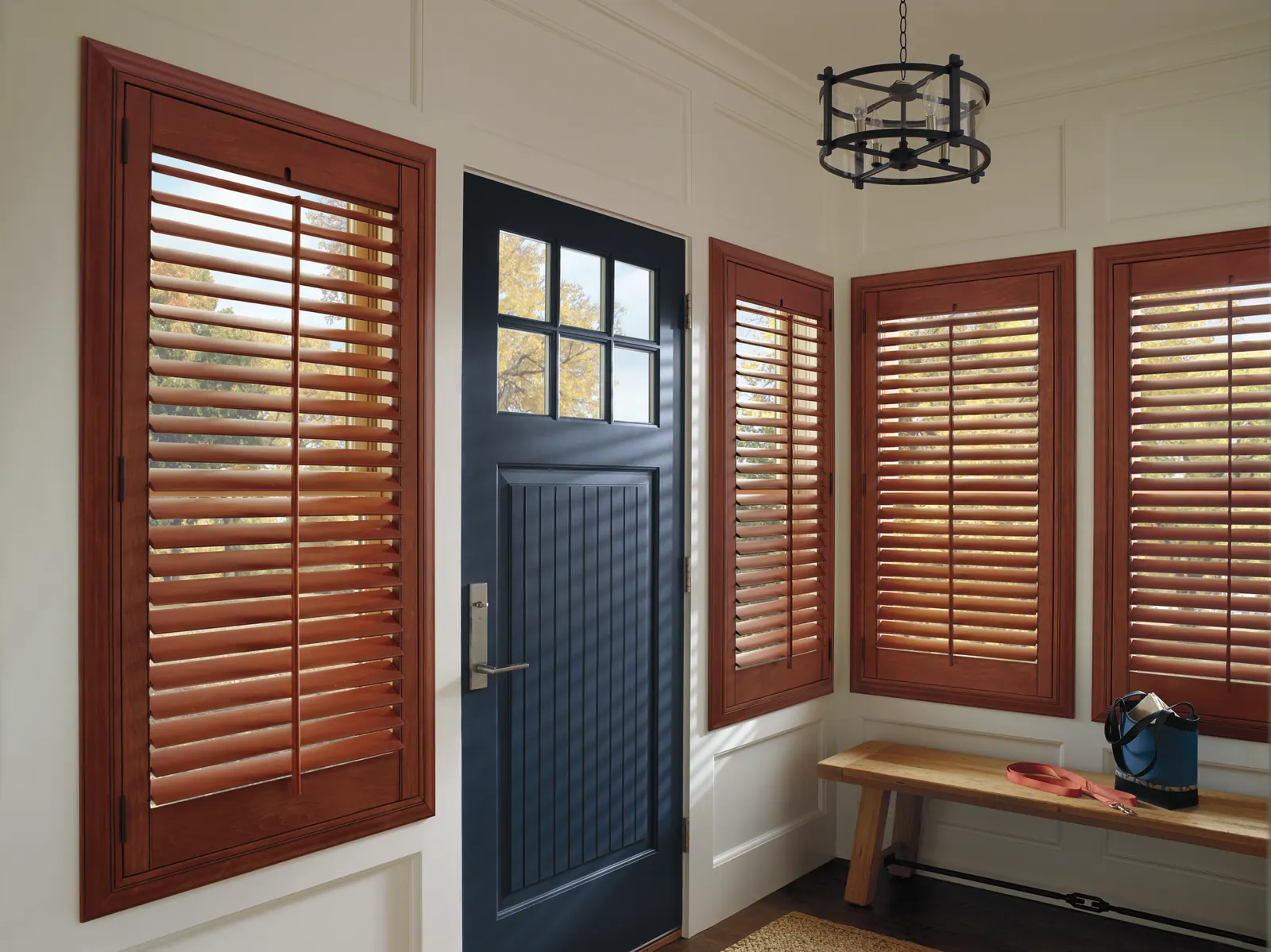
- You want a stained finish that shows grain. Composite cannot convincingly imitate stained wood.
- The span is wide. Basswood is lighter than composite, so a hardwood panel can run wider before it needs a divider rail or a T-post.
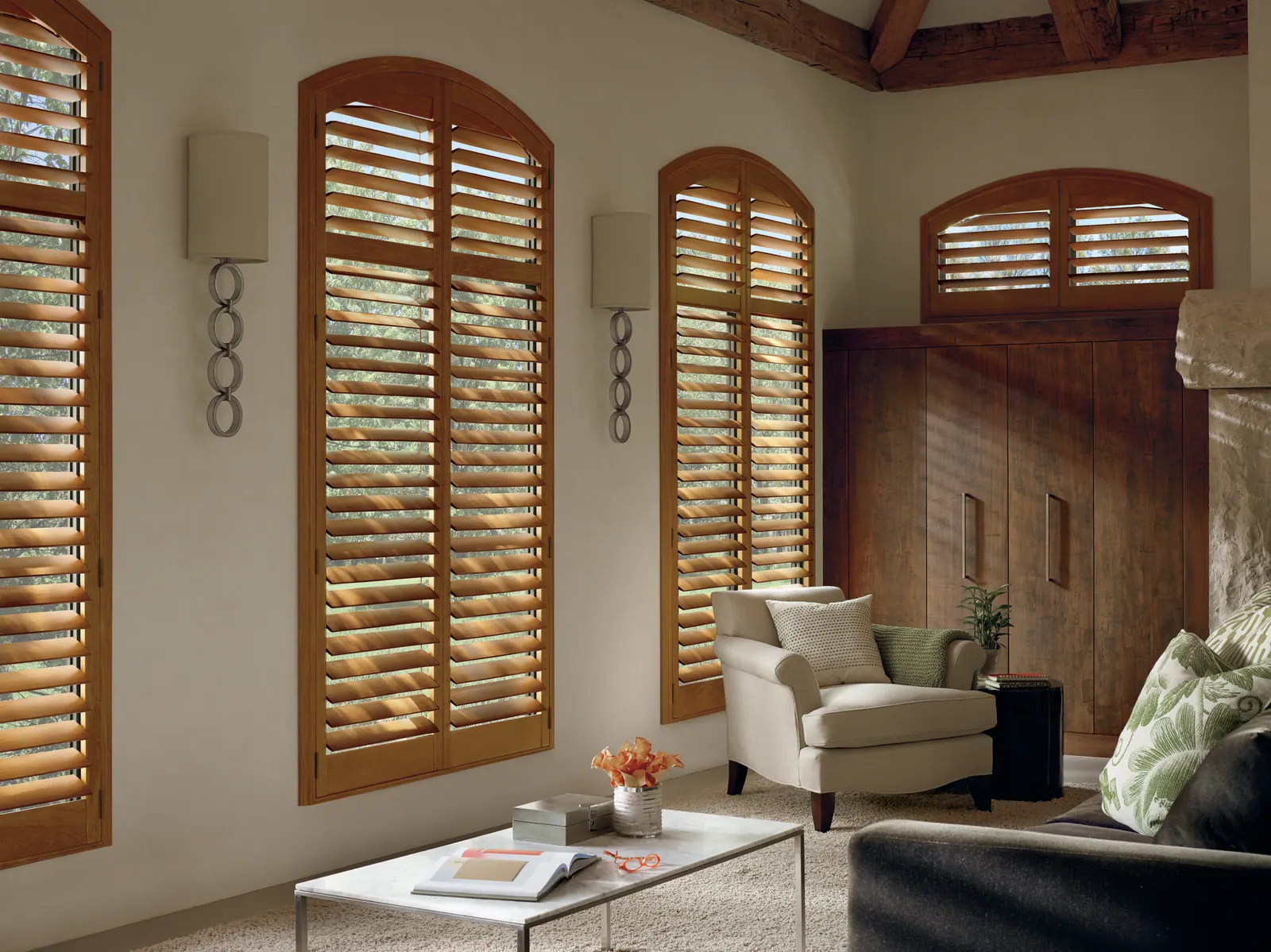
- The window is a feature: an arch, a bay, an octagon. Specialty shapes are cut from hardwood.
- The room is climate-controlled and reasonably stable.
Choose composite when
- The room gets wet or steamy. Bathrooms, laundry rooms, kitchen sink windows.
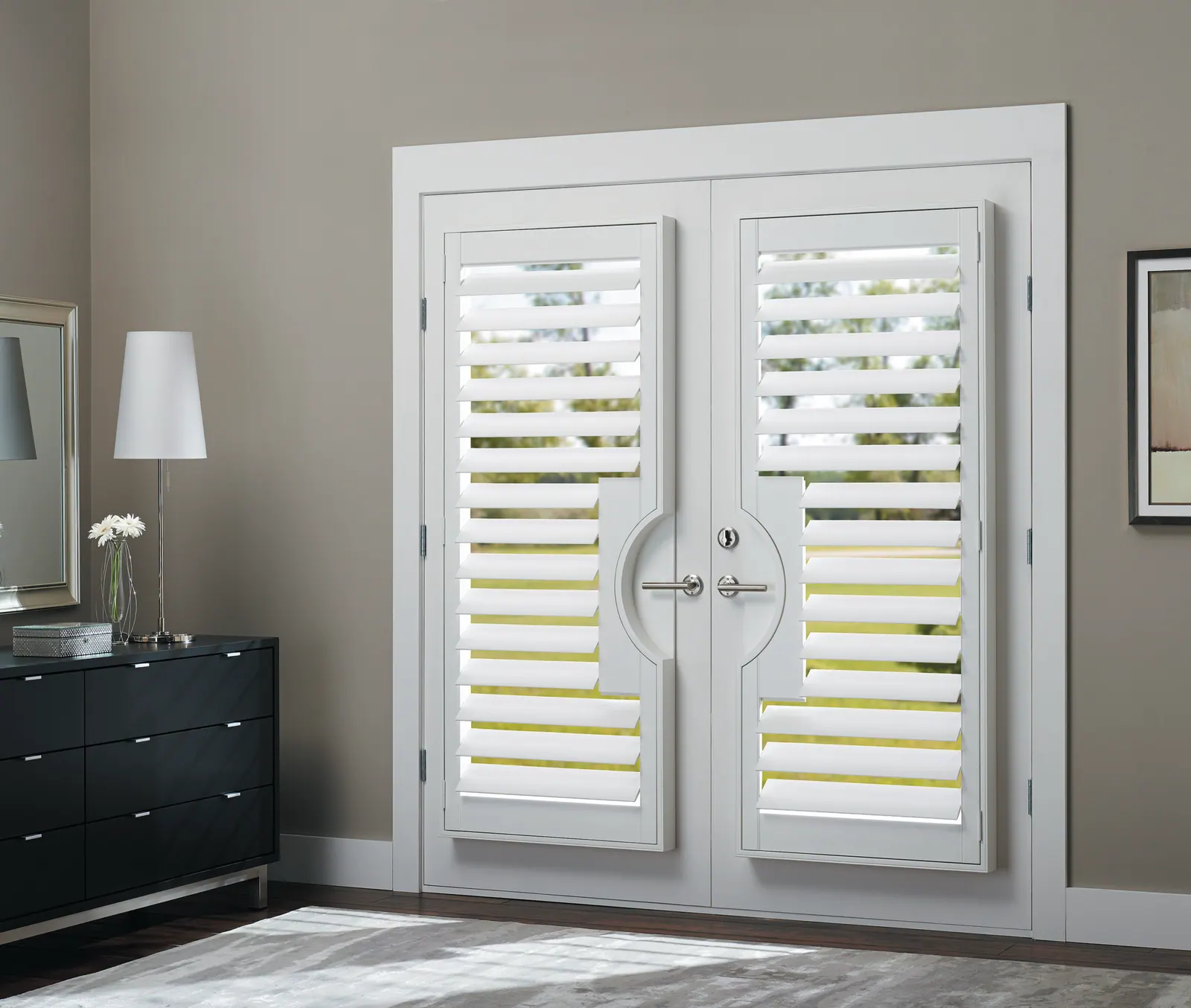
- The window is south or west facing and gets punished all afternoon. Composite will not warp or check.
- You want white or off-white anyway, which covers the large majority of Colorado Springs installs, and satisfies most HOA rules about what the exterior of your windows may look like.
- Budget matters. Composite typically runs 15–25% less than hardwood in the same configuration.
Read the full breakdown on our plantation shutters and composite shutters pages, or see Plantation Shutters: Wood vs Composite for a side-by-side comparison.
Louver size changes the whole look
This is the decision homeowners most often underestimate. Louver width controls how much view you get when the shutter is open, how much light comes through, and how traditional or contemporary the room reads.
- 2½ inch: the traditional look. More louvers per panel, a finer texture, and the tightest closure. Best in smaller windows, cottages, and older homes around Old Colorado City and Patty Jewett where the windows are modestly sized.
- 3½ inch, the most popular size we install, and a sensible default. Enough view through the open louvers to keep a room feeling light, still fine enough to look considered.
- 4½ inch, the contemporary choice. Fewest louvers, most unobstructed view when open. This is what we usually specify when a window frames Pikes Peak or the Front Range and the whole point is the view.
In a home with a mountain view, the louver size decision often matters more than the material. We bring physical samples to every consultation so you can hold them up to the actual window rather than guessing from a brochure.
Hidden tilt, split tilt, and how you operate them
The tilt mechanism is the visible hardware that moves the louvers. There are three common approaches, and the choice is aesthetic as much as functional.
A standard tilt rod runs down the centre of the panel. It is the classic look, it is the most durable, and it is what most people picture when they picture a shutter.
A hidden tilt moves the mechanism into the side of the panel, leaving the face clean and uninterrupted. It suits contemporary interiors and it maximises the view through open louvers. It costs a little more and it is the single most requested upgrade we sell.
A split tilt (sometimes called a divider rail with independent operation) lets the top and bottom halves of a panel move separately. This is genuinely useful on street-facing windows: close the bottom for privacy while the top still brings in daylight. If you are in a walkable neighbourhood or your front rooms face a sidewalk, ask about it.
What it costs and how long it takes
Shutters are the most expensive window treatment we sell, and it is worth being straightforward about that. A composite shutter on a standard bedroom window generally lands in the mid hundreds of dollars installed; hardwood on a large or specialty opening runs meaningfully more. Whole-home projects are quoted per opening after measurement, because a shutter is priced on its actual dimensions rather than a rounded-up size bracket.
What you are buying at that price is permanence. A quality shutter outlasts three or four sets of blinds, adds to appraised value in a way that soft treatments do not, and does not need replacing when you repaint. Most of the shutters we installed in the mid-2000s are still in service.
Lead time is typically four to six weeks from approved measurement to installation. Specialty shapes and stained hardwood run longer. We will give you a real date at the point of order rather than an optimistic one.
How we measure and install
Accurate measurement matters more with shutters than with anything else we sell, because a shutter is fitted into the opening rather than hung in front of it. A small error is visible, and it is not correctable with a bracket adjustment afterwards.
We measure square, plumb and diagonal on every opening, and we check for the things that catch people out: window cranks, sill depth, alarm sensors, tile returns, drywall wraps without a frame. If your opening needs a build-out frame to take a shutter, we will tell you at consultation rather than on installation day.
Common questions
- Do shutters add value to a home?
- They are one of the few window treatments that appraisers and buyers treat as a fixture rather than a furnishing, because they are fitted to the opening and convey with the house. In the Colorado Springs market we consistently hear from clients that shutters were called out positively in listings and showings, particularly on street-facing rooms.
- Will shutters block my mountain view?
- Open louvers always obstruct a view to some degree. That is unavoidable with any louvered product. The way to minimise it is a wider louver, usually 4½ inch, which means fewer horizontal lines across the glass. If the view is the entire reason for the room, we may recommend a solar screen or roller shade for that specific window and shutters everywhere else.
- Can shutters be fitted to arched or angled windows?
- Yes. Arches, eyebrows, octagons, angled tops and circles are all possible in hardwood. Arched shutters can be built as a fixed sunburst panel or with operable louvers. We template specialty shapes on site rather than working from a stated dimension.
- How do I clean shutters?
- A dry microfiber cloth or a vacuum brush attachment handles routine dust: run it along the louvers with them tilted open, then tilt the other way and repeat. For composite, a barely damp cloth with mild soap is fine. Avoid soaking hardwood, and never use ammonia or abrasive cleaners on a painted finish. Our full guide is at [How to Clean and Maintain Your Blinds & Shutters](/clean-and-maintain-blinds-and-shutters/).
- Do you install shutters outside Colorado Springs?
- Yes. We regularly install in Monument, Castle Rock, Black Forest, Palmer Lake, Larkspur, Woodland Park, Peyton, Manitou Springs and Parker. There is no additional travel charge inside that service area.