
Full sun, no shade, all day
In Black Forest a house might be under ponderosa cover. In Peyton, most properties have no meaningful natural shade at all, which means every window takes the full sun for as long as the sun is on that side of the house.
This is the most demanding sun environment we work in, and it shows up in how quickly ordinary materials degrade. Cheap vinyl yellows. Unstabilised fabrics fade unevenly. Real wood on a west window bows within a few seasons.
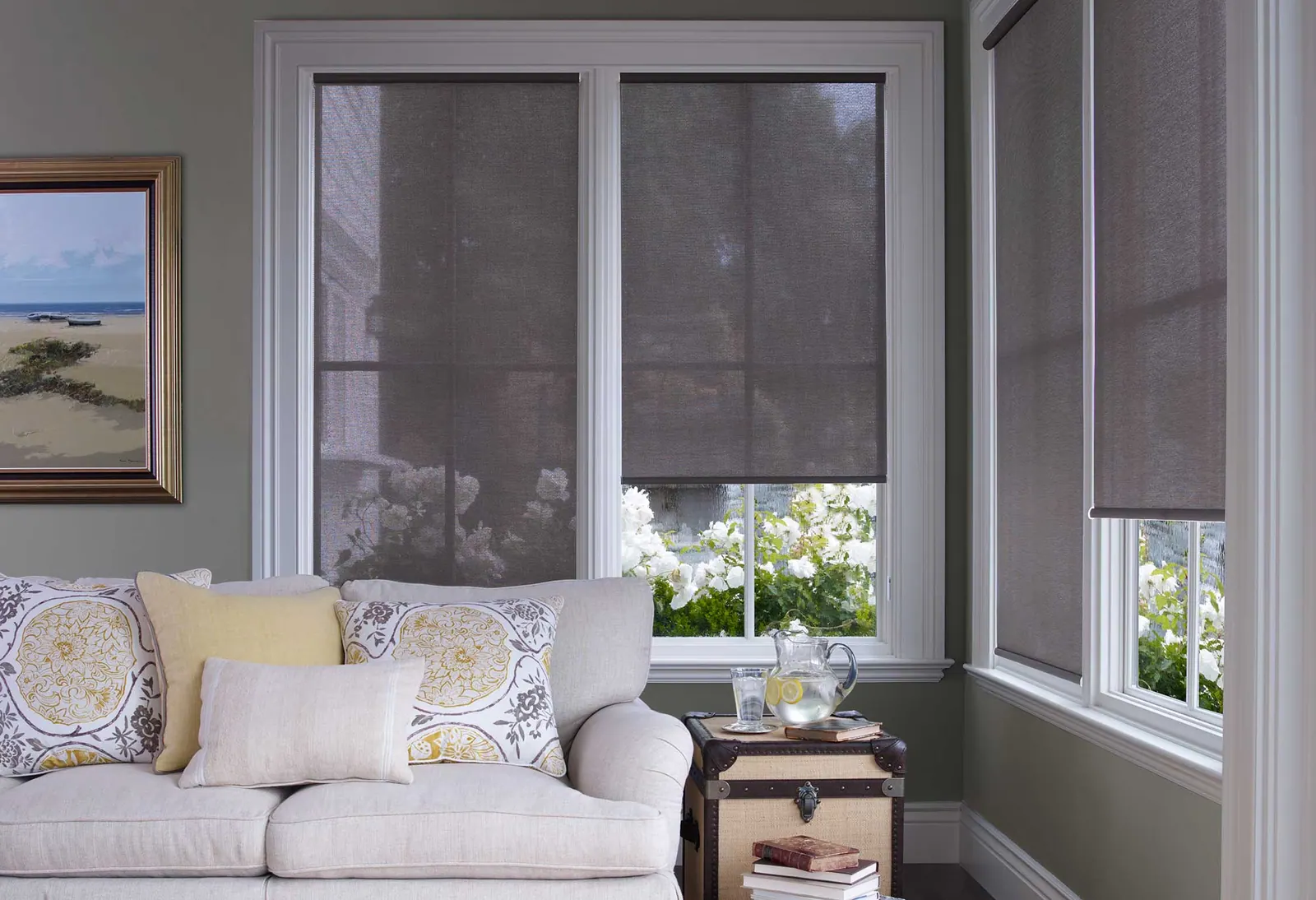
What we specify here: solution-dyed fabrics where the pigment is in the fibre rather than on it. [Composite shutters](/window-treatments/shutters/composite-shutters/) rather than hardwood on sun-facing elevations. [Solar screens](/window-treatments/window-shades-company/roller-screens/) at a tighter 1% or 3% openness than we would use in town, because there is no tree canopy taking the edge off first. And where budget allows, window film as a permanent baseline that works whether or not anyone operates a shade.
Wind, dust and what survives it
The plains wind is constant, and it carries dust. Both matter more than people expect when choosing window coverings.
Interior blinds at an open window rattle in a breeze, and out here there is usually a breeze. A properly weighted bottom rail helps considerably; hold-down brackets fixed to the sill eliminate it entirely and are worth specifying on any window that gets opened.
Exterior treatments need to be robust or retractable. Sustained wind and blowing grit are hard on exterior screens, and hail on open ground has nothing to break its fall. Where clients want exterior screens we specify heavy housings and side tracks, and we discuss retracting them during storm season.
Dust favours hard surfaces. Fabric shades and cellular cells collect fine dust that has to be vacuumed out; faux wood and aluminum wipe down with a damp cloth in seconds. In a house on a dirt road, that difference is worth real money in time.
Privacy without giving up the sky
Peyton properties usually sit on acreage with distant neighbours, which inverts the usual privacy calculation. In town, privacy is the main reason for a window covering. Out here, most windows do not need it at all, and the ones that do are usually roadside.
That means light control and heat are the real jobs, and it opens up options that would not work in a subdivision. Solar screens that are transparent from the inside are perfectly acceptable on a window nobody can see into from half a mile away. Top-down bottom-up shades can be left mostly open. A great room facing empty grassland can take a treatment specified purely for sun.
We ask about sightlines during the consultation rather than assuming, because in Peyton the answer is frequently 'nobody can see this window'. And that saves you money on a treatment specified for a problem you do not have.
Where we work in Peyton
Neighborhoods
Peyton · Falcon · Meridian Ranch · Woodmen Hills · Latigo · Judge Orr
ZIP codes served
80831 · 80808
What we install in Peyton
Peyton questions
- Do you charge extra to come out to Peyton?
- No. Peyton is inside our regular service area, and the in-home consultation is free with no travel charge. We schedule Peyton appointments in blocks so we can offer you a tighter arrival window rather than a half-day range.
- How long does an installation in Peyton take?
- Most whole-home installations are done in a single day. A few large windows or specialty shutters can run into a second visit, and we tell you which applies before you order rather than on the day.
- What is the lead time from measurement to installation?
- Typically two to four weeks for blinds and shades, and four to six weeks for custom shutters. Specialty shapes and stained hardwood run longer. You get a real date at the point of order.
- What holds up best in full sun with no shade?
- Composite shutters and quality faux wood blinds on the structural side, and solution-dyed fabrics where you want a shade. The thing to avoid is bargain vinyl, which yellows and goes chalky faster out here than anywhere else we work. Window film is also worth considering as a permanent baseline that protects your floors and furniture regardless of whether a shade is closed.