
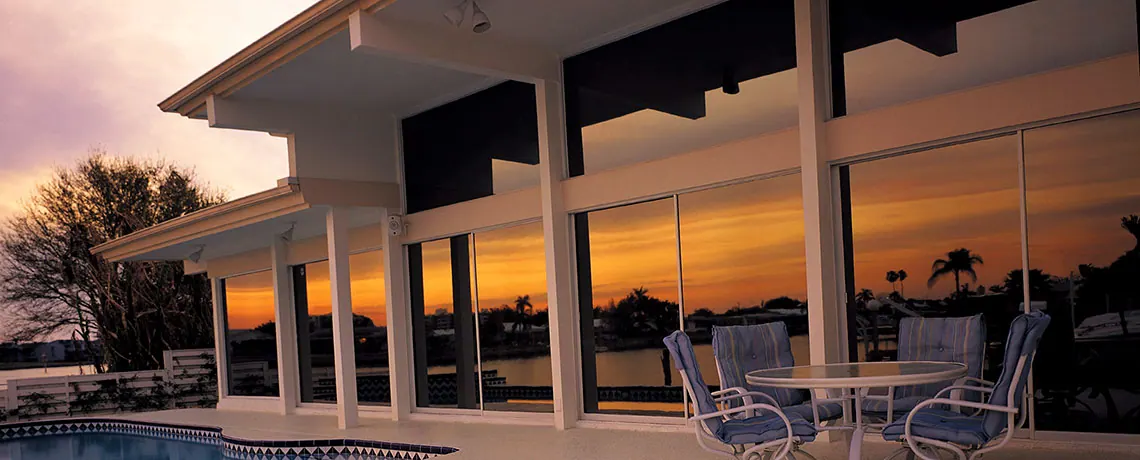
Why tint makes particular sense in Colorado Springs
Three local conditions push this product up the list.
Ultraviolet load. UV intensity climbs roughly 4% per 1,000 feet of elevation. At 6,035 feet, and with more than 300 sunny days a year, interiors here take a beating that surprises people who have moved from lower elevations. Hardwood floors lighten. Rugs lose their colour along the sun line. Leather furniture dries and fades. Artwork suffers permanently.
Big glass. Local construction over the last two decades has favoured large windows and window walls, frequently oriented west toward the mountains. That is a lot of aperture for solar energy.
Views worth protecting. The whole reason for that glass is what you see through it. Any solution that covers the window undermines the reason the window is there. Film does not cover anything.
A high-quality film blocking 99% of UV is, in straightforward terms, cheaper than refinishing a hardwood floor once.
The three kinds of film
Ceramic film
Microscopic ceramic particles reject infrared heat while staying optically clear. It is the best-performing residential film available: high heat rejection, minimal visible tint, no metallic look, and no interference with Wi-Fi, cellular signal or radio. It is also the most expensive, and it is what we recommend for main living spaces and view windows.
Spectrally selective film
Engineered to reject infrared and ultraviolet while passing visible light. The result is high heat rejection with very little darkening, useful when you want the thermal benefit but not a noticeably tinted window.
Dyed film
The economical option. It absorbs light and heat rather than reflecting it, which makes it less efficient thermally, and the dye fades over years. Fine for secondary windows and budget-constrained projects; not what we would put on a west-facing great room.
We avoid heavily metallised films on residential work. They perform reasonably but they look mirrored from outside and they can interfere with signal.
Tint or a solar screen?
These two products solve overlapping problems and clients often ask which to choose. The honest answer is that they are complementary.
Film is permanent and invisible. It works 24 hours a day with no operation, does not change the appearance of the room, and cannot be forgotten about. But its level of heat and glare reduction is fixed at installation, on a grey January afternoon you still have it.
A [solar screen](/window-treatments/window-shades-company/roller-screens/) is adjustable. You raise it when you want full light and lower it when the sun is punishing. But it is a visible treatment with a headrail and a stack, and someone has to operate it, or you motorise it.
For a west-facing room with severe afternoon sun, the configuration that works best is usually both: film for the constant UV protection that saves your floors and furniture, and a screen or shade for the hours when the sun is directly in the window. On east and north windows, film alone is often sufficient.
What to know before you commit
Warranty on the glass. Some window manufacturers void their seal warranty if aftermarket film is applied, particularly on certain low-E and gas-filled units. We check your window type before recommending a film and will tell you if there is a conflict.
Thermal stress. Dark absorptive films on large panes of annealed glass can create heat stress. We match film type to glass type rather than applying one product everywhere.
HOA rules. Some associations regulate the exterior reflectivity of window film. Non-reflective ceramic films are almost always compliant, but if your HOA requires approval we can supply the specification.
It goes on the inside. Residential film is applied to the interior surface, so it is protected from weather and hail, which matters here.
Installation quality is everything. A poorly installed film has bubbles, edge lift and dust inclusions, and there is no fixing it short of removal and replacement. This is not a DIY product on large residential glass.
Common questions
- Does window tint really reduce heat?
- Quality ceramic and spectrally selective films reject a substantial share of solar heat, most of it in the infrared band that you feel as warmth. The effect is most noticeable on west and south windows during summer afternoons. Dyed films help considerably less, because they absorb heat rather than rejecting it, and some of that absorbed heat still transfers into the room.
- Will window film make my rooms dark?
- Not necessarily. Ceramic and spectrally selective films are engineered to reject heat and UV while passing visible light, so a room can stay bright while feeling considerably cooler. If you want darkening as well, that is available. But it is a separate choice from heat rejection, not an inevitable side effect of it.
- How long does residential window film last?
- A quality film installed on interior glass typically lasts 15 to 20 years, and manufacturer warranties often reflect that. Dyed films have shorter useful lives because the dye fades. The film is protected from weather by the glass itself, which is why interior application outlasts exterior.
- Can window tint be removed later?
- Yes, though it is a slow job, the film and its adhesive both have to come off without scratching the glass, and it is worth having done professionally. If you are unsure about a whole-home application, start with the worst two or three windows and live with them for a season.
- Does window film provide privacy?
- Reflective and frosted films do. Clear ceramic films, which are what we mostly install for heat control, provide very little privacy. They are designed to be optically clear. If privacy is a goal alongside heat rejection, say so at consultation, because it changes which film we recommend.