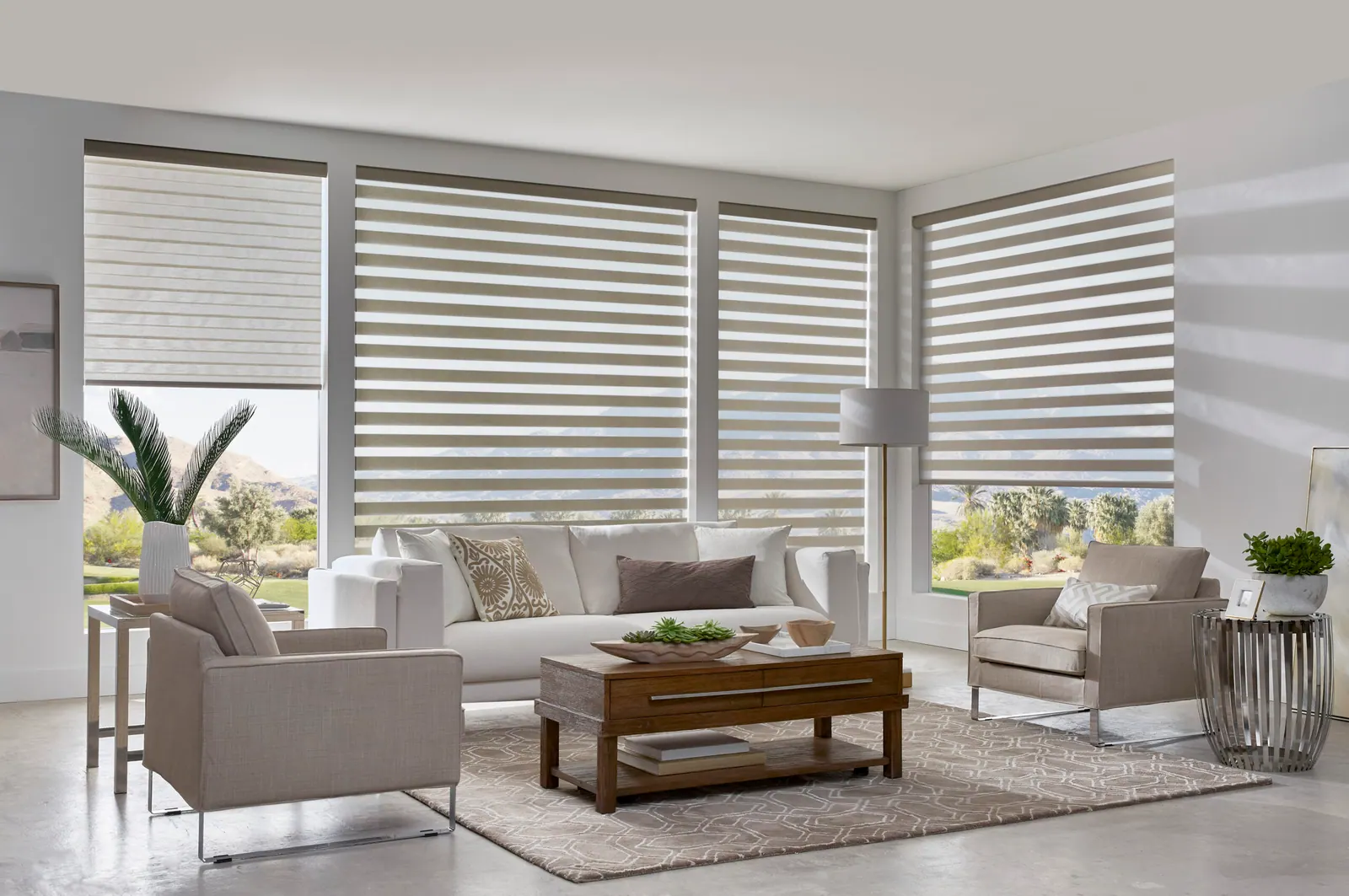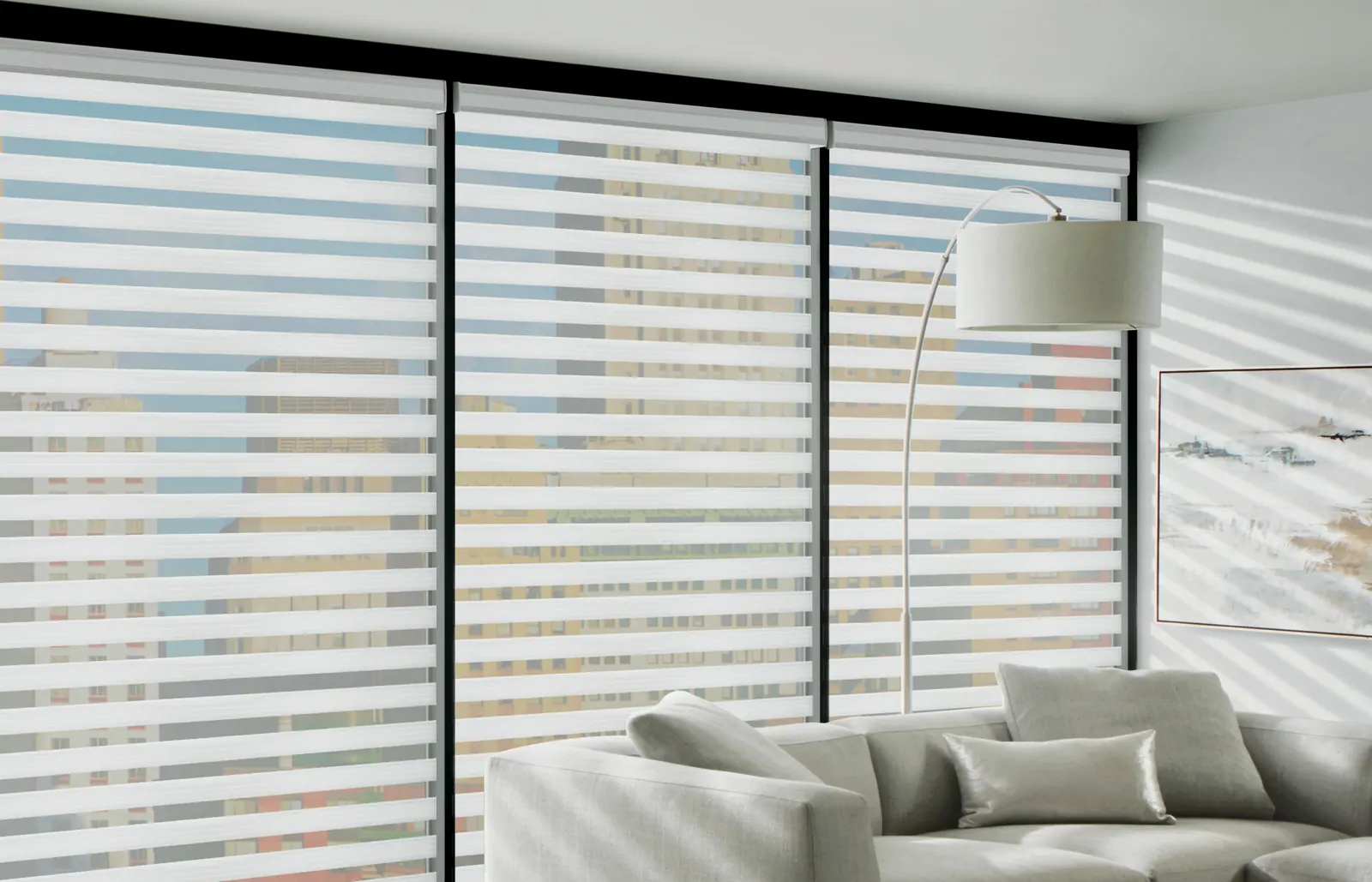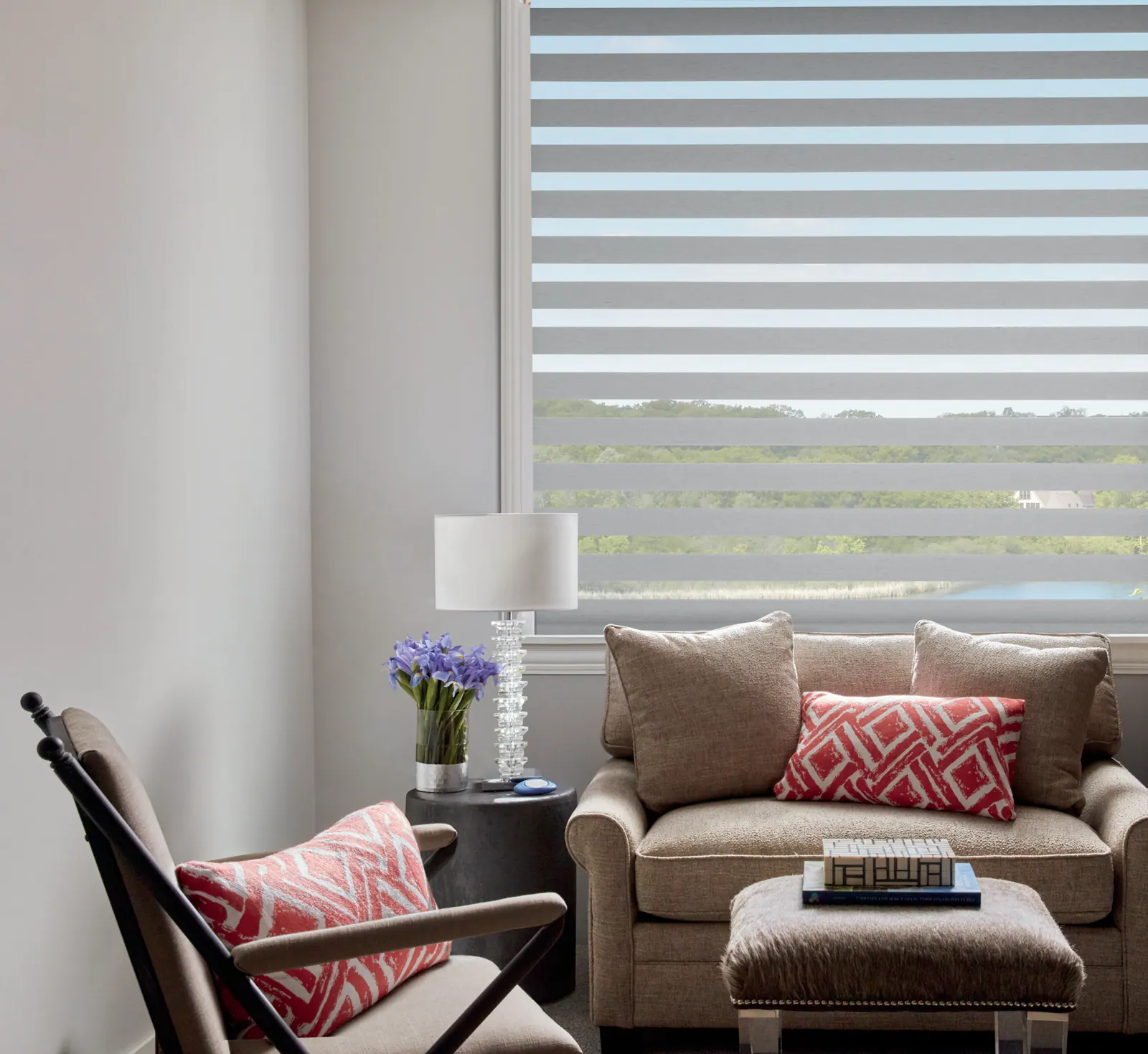
How the banding works
The shade is a single continuous loop of fabric with horizontal stripes alternating between an open sheer weave and an opaque solid. The loop passes over a roller at the top, so the front layer and the back layer move in opposite directions relative to each other.
When the sheer bands on the front align with the sheer bands on the back, you get a striped but see-through window: light comes in, and you can look out. Nudge the shade two or three inches and the solid bands on the front move to sit behind the sheer bands on the back. Now the window is fully closed, and you have not changed how much of the glass is covered.
That is the whole idea, and it is genuinely useful. Most window treatments make you trade coverage for view; a dual shade lets you keep the window fully covered and change what covering means.
The room where this actually matters
A living room used from morning through late evening is the case dual shades were designed for. In daylight you want the view of the Front Range and as much light as you can get. After dark, with lamps on, that same window becomes a mirror to the street and you want it closed. With a roller shade you are raising and lowering it; with a dual shade you are nudging it.
The same reasoning applies to home offices (video calls need controlled light and no glare on the screen, but you would like to see out between them) and to street-facing dining rooms.
Where dual shades are a weaker choice is a bedroom. Even with the solid bands aligned, a dual shade is not a blackout product; light passes at the band junctions. For sleeping rooms, a blackout roller or blackout honeycomb is the right tool.
What to look for in a good one
This category has a wide quality range, and the differences are not obvious in a showroom.
- Band alignment. On a cheap shade the front and back bands drift out of parallel across the width, so one side closes before the other. Good construction holds alignment across the full span.
- Fabric weight. A light fabric flutters at an open window and can bow away from the glass. Enough body keeps the bands hanging true.
- Cassette headrail. The loop mechanism is more visible than a standard roller's, and a wrapped cassette tidies it considerably.
- UV-stable sheer. The sheer band is the vulnerable component here. It is a fine open weave taking direct high-altitude sun. A poor sheer goes brittle and yellow. This is the single biggest predictor of how a dual shade looks in year six.
We carry these in a range that holds up to Colorado exposure, and we will happily show you the difference between a well-made banded shade and a bargain one side by side.
Sizing and stack
Dual shades stack a little larger than a standard roller because the fabric is doubled. It is a loop, so there are two layers on the tube. On an inside mount, check that the frame depth accommodates the roll; on a very small window the stack can look disproportionate.
They scale well up to large windows and are a good option for wide living room glass, though as with any roller product there is a width limit before the fabric can distort. We split wide openings into a pair on a shared headrail where necessary.
For patio doors, a dual shade works but so does a vertical alternative, and the choice usually comes down to whether you want the door to read as a window or as a door.
Common questions
- What is the difference between zebra shades and dual shades?
- None. They are the same product. 'Zebra' comes from the striped appearance, 'banded' from the construction, 'dual' from the two fabric types, and 'transitional' is what several manufacturers call them in their catalogues. If you have been quoted for any of those four, you have been quoted for this.
- Can people see in through dual shades at night?
- With the solid bands aligned, no, that position is opaque. With the sheer bands aligned, yes, in the same way any sheer works: fine during the day when it is brighter outside than in, revealing at night when your lights are on. The point of the product is that switching between the two takes a couple of inches of movement.
- Are dual shades good for blocking heat?
- In the closed position they perform much like a standard roller shade of the same fabric, which is to say they cut solar heat gain effectively. In the open position they let light and heat through by design. They are not an insulating product in the way a cellular honeycomb shade is.
- How do you clean dual shades?
- Dust with a vacuum brush attachment on low suction, working across the bands rather than up and down. The sheer sections are delicate, so be gentle. Spot clean with a barely damp cloth and let the shade dry fully extended before operating it.
- Do dual shades work in a bathroom?
- They can, but the sheer bands take longer to dry than a solid fabric and repeated humidity is not kind to them. For a bathroom we would usually recommend a faux wood blind or a composite shutter, both of which are indifferent to steam.