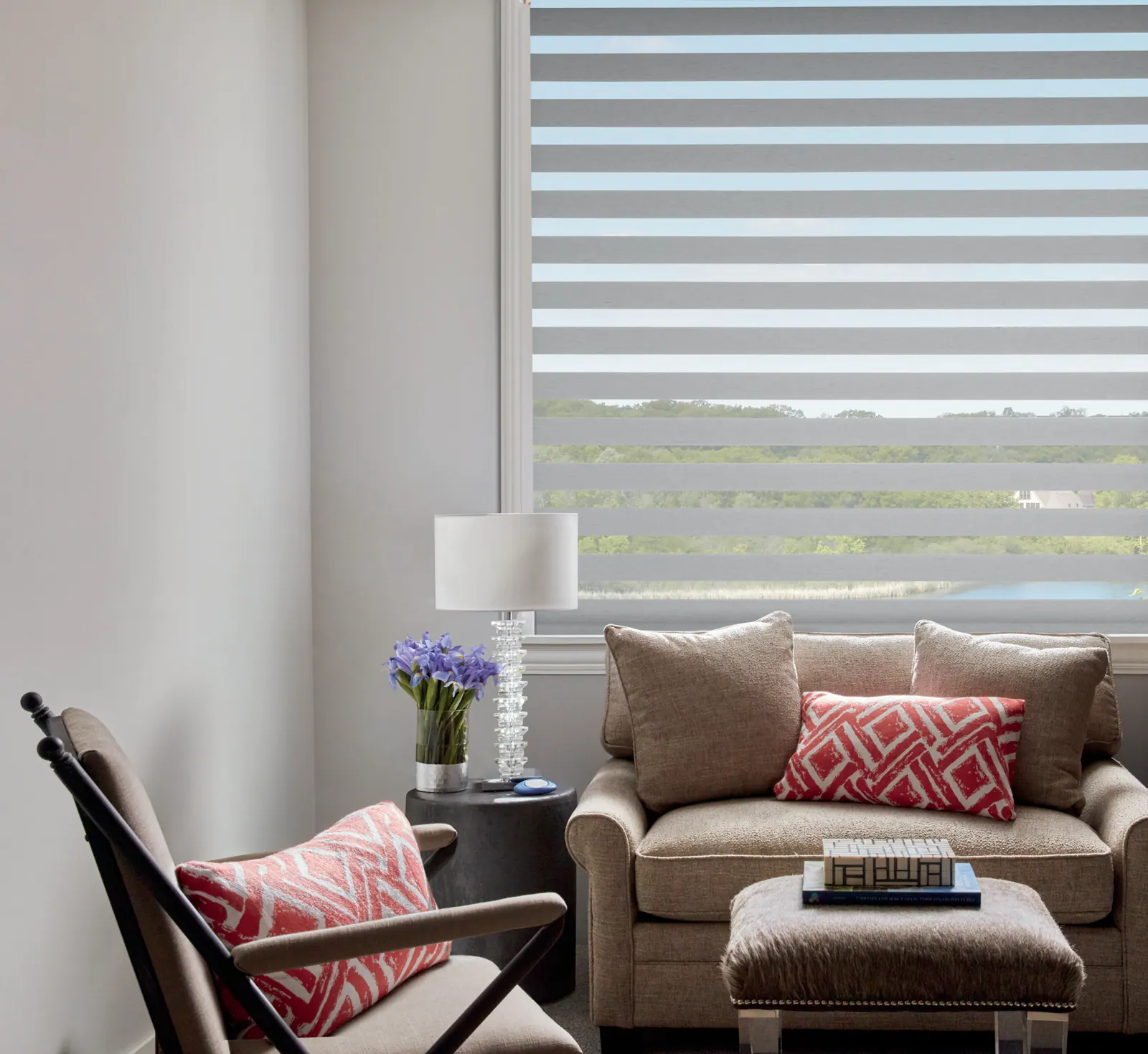
Zebra shades, banded shades, dual shades, transitional shades, four names for one product. Alternating stripes of sheer and solid fabric run on a continuous loop, and moving the shade a few inches switches the window between open view and full privacy without changing how much glass is covered.
How the banding works
The shade is a single continuous loop of fabric with horizontal stripes alternating between an open sheer weave and an opaque solid. The loop passes over a roller at the top, so the front layer and the back layer move in opposite directions relative to each other.
When the sheer bands on the front align with the sheer bands on the back, light passes and you can see out. Nudge the shade two or three inches and the solid bands on the front move behind the sheer bands on the back. Now the window is fully closed.
Crucially, the shade has not moved up or down in any meaningful way, the glass is still covered. That is the whole idea. Most window treatments make you trade coverage for view; a dual shade lets you change what coverage means.
The room this was designed for
A living room used from morning through late evening. In daylight you want the Front Range view and as much light as possible. After dark with lamps on, that same window becomes a mirror to the street and you want it closed.
With a roller shade you are raising and lowering. With a dual shade you are nudging. The same logic applies to home offices (video calls need controlled light and no screen glare, but you would like to see out between them) and to street-facing dining rooms.
What separates a good one from a cheap one
This category has a wide quality range and the differences are not obvious in a showroom.
- Band alignment. On a poor shade the front and back bands drift out of parallel across the width, so one side closes before the other.
- Fabric weight. Light fabric flutters at an open window and bows away from the glass.
- Cassette headrail. The loop mechanism is more visible than a standard roller's, and a wrapped cassette tidies it considerably.
- UV-stable sheer. This is the big one. The sheer band is a fine open weave taking direct high-altitude sun, and a poor sheer goes brittle and yellow. It is the single biggest predictor of how the shade looks in year six.
Where they are the wrong choice
Bedrooms. Even with the solid bands aligned, a dual shade is not blackout, light passes at the band junctions. Use a blackout roller or blackout honeycomb.
Bathrooms. The sheer bands take longer to dry than solid fabric and repeated humidity is unkind to them.
Cold rooms. They provide essentially no insulation. A cellular honeycomb shade is the answer.
Common questions
- What is the difference between zebra shades and dual shades?
- None, the same product. 'Zebra' comes from the striped appearance, 'banded' from the construction, 'dual' from the two fabric types, and 'transitional' is what several manufacturers call them. If you have been quoted for any of those four, it is this.
- Can people see in through dual shades at night?
- With the solid bands aligned, no, that position is opaque. With the sheer bands aligned, yes, in the way any sheer works: private during the day when it is brighter outside, revealing at night when your lights are on. Switching between them takes a couple of inches of movement.
- Are dual shades worth the extra cost over roller shades?
- In rooms used across the whole day, yes, the flexibility is genuinely useful and you will use it daily. In a bedroom or a room you only occupy in the evening, a straightforward roller shade does the job for less.